One of the concrete signs of our global brotherhood is the concern we show for our brothers natural disasters strike or other troubles occur. When the tsunami hit Indonesia years ago, offers of help came from provinces throughout the world. After the earthquake in Aquila, Italy, and after the recent earthquake in Indonesia, many brothers asked how they could help. Given the news of frequent bombings and shootings in Pakistan, I am often asked about the situation of our brothers there. Two weeks ago, I conducted an economic visitation of the Vice Province of Pakistan so I was able to see the situation for myself.

The Vice Province of Pakistan had its beginnings over 150 years ago when the British Army invited Capuchins to serve as military chaplains in India. The original Italian missionaries were soon replaced by friars from France. Later, in the 1880’s, the French Capuchins were replaced by friars from Belgium. Today there are about 40 friars in the Vice Province, of whom three are from Belgium while the rest are Pakistanis. They are involved primarily in parochial ministry, although they also run a few schools.
Although priests and religious have rarely been specifically targeted by extremists in Pakistan, they share the plight of all Pakistanis. A bomb planted by a terrorist group outside a police training center last March blew out the windows and splintered several doors in one of the friaries in Lahore. Beyond the dangers caused by frequent bomb blasts and gun battles between the military and the extremists, the friars share additional difficulties with the rest of the Christian community in the country. Christians account for only 3% of the population in Pakistan, and they are often looked upon as outsiders. Various attempts to “Islamicize” the country have made their situation even more perilous. Officially, Christians (as all minorities) are tolerated and even protected. Clearly, however, minority groups do not enjoy equal rights. The clearest example of this disparity is the country’s blasphemy laws. The effects of these laws was made clear in a recent case.
In one of the villages where the friars minister, a young Christian man befriended a Muslim girl. There was nothing unusual in this since interreligious marriages are not uncommon in Pakistan. At some point, the relationship was broken off, which apparently displeased the parents of the girl. They exacted their revenge by accusing him of blasphemy. The local police arrested the young man, and threw him into a jail cell with a group of Muslim prisoners. These prisoners began to beat the young man mercilessly. He was then taken to a solitary cell, where the police continued to torture him. Eventually, they strangled him to death. According to the official police report, the young man hung himself, but the
autopsy clearly showed marks that were inconsistent with hanging. Despite clear evidence of police brutality leading to death, nothing will be done to discipline them. Another false accusation of blasphemy in Gorja, Pakistan, culminated with a mob torching the houses of several Christian families. Such cases are common enough that even some Muslims are calling for the abolition of blasphemy laws.
The unequal treatment of Christians is also seen in employment opportunities. Christians are often trapped in low-paying jobs, with few opportunities for advancement. Christian children are treated with such contempt in the public schools that many will not attend school at all unless there is a Catholic school nearby. In this way, the cycle of poverty is continued.
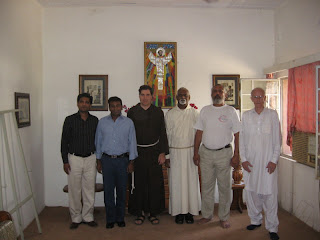
While the situation may seem bleak, our brothers in Pakistan are working diligently to improve the lives of Christians in the country. One of the brothers works extensively in the area of interreligious dialogue. It is a work that requires great patience since progress comes in small, slow steps. The brothers have also opened many schools, both in the cities and in the villages. Through education, they are slowly improving the lives of the poor and helping to eradicate an extremism that preys on ignorance. Through their work in the parishes, they help the parishioners to strengthen the sense of community and interdependence among the Catholic community. One might say that the primary ministry of the Vice Province is one of providing hope to the people of Pakistan.
 A total of twenty friars make up the Vice Province—fourteen on the island of Guam (including Archbishop Anthony Apuron) and six in Hawaii. Seven of the friars are from the mother Province of New York/New England, one is from Hawaii and the rest are from Guam. Although the Vice Province is among the smaller jurisdictions numerically, it is probably the largest geographically; 3,800 miles (6,120 km) separate Guam and Hawaii. Flying from one to the other takes over seven hours. As you can imagine, this presents a formidable challenge to the friars’ ability to get together and to maintain a sense of unity. Furthermore, while Guam and Hawaii have many things in common—a tropical climate, the island mentality of its residents, and a substantial number of Filipino and Pacific Islander immigrants, to name a few—there are also significant differences. The fact that Hawaii is one of the fifty states of the United States and its proximity to the American mainland (it is “only” a five hour flight) means that Hawaii is heavily influenced by the culture of mainland America. Guam, although a territory of the United States since 1898, was first colonized by Spain, and the Spanish influence can still be seen, especially in Guam’s religious devotions. Guam is also more strongly influenced by Asian and Pacific cultures than Hawaii. In fact, the Archdiocese of Guam belongs to the Episcopal Conference of the Pacific. Practically speaking, this means that the church in Hawaii struggles with a lot of the same issues as that of the mainland, such as falling Mass attendance, fallout from sexual abuse scandals, and clergy shortages. The church in Guam is not untouched by these struggles, but it does not experience them quite as strongly. Sunday Mass attendance is still high, and even weekday Masses will have a good attendance. Devotions to the saints, especially St Jude and St Anthony, are also strong.
 There are also some significant differences in the experience of the Order on the two islands. The missions in the Marianna Islands was entrusted to the Capuchin Order by the Propaganda Fide so at one time Capuchins “owned” the church on Guam. Until recently, all the parishes on the island had a Capuchin pastor. As the number of secular clergy has grown, both through ordination of local vocations and the borrowing of clergy from other countries, the friars have begun to relinquish parishes to the diocesan clergy and to expand into other ministries, most notably teaching. In Hawaii, on the other hand, the local church was already quite established by the time the first Capuchins began working there. One commonality among the friars of both islands is their diminishing numbers. However, last year’s ordination of an Hawaiian friar, the presence of a Chamorro friar in the NAPCC novitiate, a candidate for next year’s postulancy and several potential future candidates gives hope that the Vice Province will continue to serve the church of Guam and Hawaii for the foreseeable future.


