The Capuchin Vice Province of the Marianna Islands/Hawaii is hosting a "Christmas Village" at Saint Fidelis Friary in Agana for the second year in a row. Each evening, hundreds of people from around the island visit the display. I produced the video below to recognize the friars' fine work and to serve as my Christmas card to all of you who did not receive one from me this year. Merry Christmas and a happy, blessed New Year.
23 December 2008


19 December 2008
Mendi welcomes the General Minister
I accompanied the General Minister to Papua New Guinea, where we participated in the friars' annual assembly from December 9 to 12. The main topic of the assembly was a study of our Constitutions, especially as they related to three policies that have been recently drafted in the Vice Province. Br. Robert Stewart of the Australian Province led the discussions.
On Thursday afternoon, December 11, Mauro, Robert and I were invited to visit the parish in Ekari (also known as Upper Mendi), where Br. Colman has ministered for years. We received a grand welcome from the members of the parish, complete with gifts of bilum hats and bags.
On Thursday afternoon, December 11, Mauro, Robert and I were invited to visit the parish in Ekari (also known as Upper Mendi), where Br. Colman has ministered for years. We received a grand welcome from the members of the parish, complete with gifts of bilum hats and bags.
18 December 2008
Chapter of Australian Province
The Chapter of the Province of Australia was held on December 1-4, 2008, in the former seminary complex in Plumpton, N.S.W. The General Minister, Br. Mauro Jöhri presided so I attended as an observer and interpreter. Besides Mauro, there were 28 other delegates at the Chapter, plus a few observers.
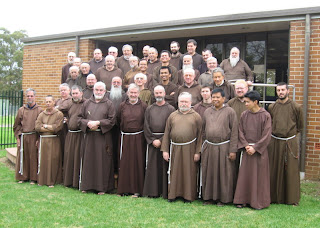 What especially struck me about the Chapter was the willingness of the brothers to look forward in faith. As I mentioned in my post-visitation blog entry, the Province has been working for many years to redefine the image of Capuchins in Australia, from that of an Italian Order that works principally with Italians to a multi-cultural Order working in a wide variety of ministries, but with a special emphasis on youth ministry.
 The positive, forward-looking spirit was undoubtably helped by the fact that the Province has been experiencing a good influx of new vocations. In fact, the Province's six postulants paid a visit to the Chapter one day. Br. Robert Stewart gave a very interesting presentation on the Province's efforts in the area of vocation promotion and the mentality of "Generation Y".
 What especially struck me about the Chapter was the willingness of the brothers to look forward in faith. As I mentioned in my post-visitation blog entry, the Province has been working for many years to redefine the image of Capuchins in Australia, from that of an Italian Order that works principally with Italians to a multi-cultural Order working in a wide variety of ministries, but with a special emphasis on youth ministry.
 The positive, forward-looking spirit was undoubtably helped by the fact that the Province has been experiencing a good influx of new vocations. In fact, the Province's six postulants paid a visit to the Chapter one day. Br. Robert Stewart gave a very interesting presentation on the Province's efforts in the area of vocation promotion and the mentality of "Generation Y".
01 December 2008
Capuchins in the year 2050
Last month, out of the blue, I received a couple of articles from an investment company that specializes in working with nonprofit organizations. The articles dealt with world demographics for the next 40 years and the impact they would have on nonprofit organizations. The articles were real eye-openers for me, especially coming as they did just before the General Definitory met with the Capuchin Conferences of Africa, India and Asia. I would like to share with you some of the information contained in those articles.
First of all, as one article pointed out, there is no magic involved in predicting future demographic trends. Someone born today will, barring an untimely death, be fifty years old in fifty years. Demographers can know with great precision the current birth and death rates of most countries. These trends change, but at a relatively slow pace. It is, therefore, relatively easy to predict the population and age distribution of a country for a fifty year period.
The articles focused on the economic impact of demographics, with which I will deal in a later post. These populations studies alone, however, have interesting implications to ponder. Consider for instance the fact of Europe’s negative population growth. By 2050, one article stated, Europe will have lost the equivalent of the current populations of France and Italy combined. In addition, the average age of Europe’s population will continue to increase. This has tremendous implications for the future of the Order in Europe. Even if one ignores the effect of secularization, there will be far fewer young men in Europe available to enter religious life. Barring a massive change in attitudes regarding immigration and family size in the next few years, the Order’s jurisdictions in Europe will certainly continue to become smaller.
The situation in North America is somewhat different because of its higher birth rate and greater openness to immigration (at present, anyway). The population of the U.S. is expected to continue growing, but at a smaller pace than in the past. The “baby boom echo” of the 80’s and early 90’s resulted in an increase in America’s birth rate, which may partially explain the recent increase in vocations there. Youth at the “peak” of this boom are just entering their university years, which indicates that the next ten to fifteen years have the possibility of providing the greatest number of candidates to religious life since the 1960’s. Once the peak has passed, the number of vocations to religious life will slowly, but surely decline. The provinces and congregations that will profit most from this increased pool of possible candidates are those that appeal to the ever-changing sensibilities of young people and who have invested the resources to get their name in front of them.
Probably to no one’s surprise, the areas of the world that will have the greatest growth among youth, and thus the greatest potential for providing vocations to the Order, are India and parts of Africa. What some might find surprising is that China will soon enter a period of negative growth because of its “one child” policy in the past. The number of males significantly outnumbers females among China’s youth, which will add to the country’s low birth rate in the future. Asia, as a whole, will experience only slight growth in the next forty years. Vietnam has a relatively low birth rate. The population of Japan already entered a period of negative growth several years ago, and there are no signs of change for the near future. These trends have implications for our current presences in Asia and for the missions that are planned for China and Vietnam. On the other hand, there are good prospects for the continued growth of the Order in India. Strong population growth is also projected for Nigeria and the Congo, which bodes well for the future of the small, but vibrant Capuchin jurisdictions in those countries.
Overall, these figures indicate that the Order’s center of gravity will continue to move south for at least the next forty years. In many cases, the Order’s growth will be in the developing world and its greatest declines will be in the developed world. This will have important consequences for the Order’s economic solidarity, which will be the focus of my next post.
First of all, as one article pointed out, there is no magic involved in predicting future demographic trends. Someone born today will, barring an untimely death, be fifty years old in fifty years. Demographers can know with great precision the current birth and death rates of most countries. These trends change, but at a relatively slow pace. It is, therefore, relatively easy to predict the population and age distribution of a country for a fifty year period.
The articles focused on the economic impact of demographics, with which I will deal in a later post. These populations studies alone, however, have interesting implications to ponder. Consider for instance the fact of Europe’s negative population growth. By 2050, one article stated, Europe will have lost the equivalent of the current populations of France and Italy combined. In addition, the average age of Europe’s population will continue to increase. This has tremendous implications for the future of the Order in Europe. Even if one ignores the effect of secularization, there will be far fewer young men in Europe available to enter religious life. Barring a massive change in attitudes regarding immigration and family size in the next few years, the Order’s jurisdictions in Europe will certainly continue to become smaller.
The situation in North America is somewhat different because of its higher birth rate and greater openness to immigration (at present, anyway). The population of the U.S. is expected to continue growing, but at a smaller pace than in the past. The “baby boom echo” of the 80’s and early 90’s resulted in an increase in America’s birth rate, which may partially explain the recent increase in vocations there. Youth at the “peak” of this boom are just entering their university years, which indicates that the next ten to fifteen years have the possibility of providing the greatest number of candidates to religious life since the 1960’s. Once the peak has passed, the number of vocations to religious life will slowly, but surely decline. The provinces and congregations that will profit most from this increased pool of possible candidates are those that appeal to the ever-changing sensibilities of young people and who have invested the resources to get their name in front of them.
Probably to no one’s surprise, the areas of the world that will have the greatest growth among youth, and thus the greatest potential for providing vocations to the Order, are India and parts of Africa. What some might find surprising is that China will soon enter a period of negative growth because of its “one child” policy in the past. The number of males significantly outnumbers females among China’s youth, which will add to the country’s low birth rate in the future. Asia, as a whole, will experience only slight growth in the next forty years. Vietnam has a relatively low birth rate. The population of Japan already entered a period of negative growth several years ago, and there are no signs of change for the near future. These trends have implications for our current presences in Asia and for the missions that are planned for China and Vietnam. On the other hand, there are good prospects for the continued growth of the Order in India. Strong population growth is also projected for Nigeria and the Congo, which bodes well for the future of the small, but vibrant Capuchin jurisdictions in those countries.
Overall, these figures indicate that the Order’s center of gravity will continue to move south for at least the next forty years. In many cases, the Order’s growth will be in the developing world and its greatest declines will be in the developed world. This will have important consequences for the Order’s economic solidarity, which will be the focus of my next post.
30 August 2008
Under a Big Sky
Continuing my eastward trek, I crossed the Pacific Ocean and eventually found my way to Montana, U.S.A., where I made a short visit to the friars working there. Montana is aptly nicknamed “Big Sky Country” because of its vast, sparsely populated areas of semi-arid grasslands and mountains. It is also home to several Native American reservations, which were the original reason for the friars’ presence here. Due to the state’s demographics, the parishes of Montana, with the exception of those in urban centers such as Billings, Helena or Great Falls, tend to be small and far apart. Although the Capuchin friaries of Montana used to have fraternities of three or more friars, the shortage of friars in the United States has made it difficult to maintain traditional fraternities. Most of the eight Capuchins now working in Montana live alone; they do, however, have fraternal gatherings and/or chapters twice monthly.
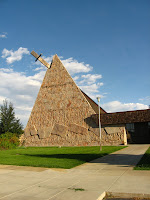 Three of the friars currently serve as pastors or sacramental ministers on the reservation of the Crow tribe, and another works on the Northern Cheyenne reservation. The other four, although not ministering on a reservation, have a significant number of Native Americans in their parishes. Most of them care for more than one parish, since there are more parishes than priests in the diocese. I was impressed and edified with the ministry of all the friars here, but especially with the ministry on the reservations. From art and architecture to the style of their ministry, the respect of the brothers for the cultures of the Crow and Cheyenne was evident. They are very much “friars of the people” here. For example, if their health permits it, the friars regularly take part in “sweats”, a ceremony that is used to create and maintain a sense of community. More than just respecting the local culture, the friars have tried to improve the life of the communities they serve, especially through education. Thanks to the efforts of the friars, there are three elementary schools and one high school on the Crow and Cheyenne reservations that students can attend free of charge. Many graduates of those schools are now employed as teachers and staff members of those same schools. Although unemployment on the reservations is still very high, the situation would clearly be worse if not for the help provided by the Capuchins.
 In the week I spent in Montana, I was able to spend a day or two each in Crow Agency, the St. Labre Mission near Ashland, the St. Charles Mission in Pryor, and Billings. I learned something about the history of the Crow tribe and its present circumstances while chatting with parishioners in Crow Agency after Sunday Mass and by visiting the site of the Battle of the Little Bighorn, in which a group of Sioux and Cheyenne warriors defeated the forces of Gen. Custer and the 7th Cavalry in 1876. That battle and the resulting reaction of the U.S. Army still has repercussions today. I even participated twice in a "sweat" (imagine a prayer meeting held in a sauna). At St. Labre Mission, I toured the fundraising operations (including mailing, receiving and printing departments) that supports its own schools as well as those of the other Capuchin missions in Montana.
What is clear to me after my visit is that the friars have poured their hearts and souls into this mission. Here, as elsewhere, they have become "friars of the people", even among people who have every reason to be wary of white men. While material poverty on the reservations in Montana is probably no worse than it is in sections of any large American city, it is tinged with a particular kind of despair among the Native Americans—a fear that any gains they make might once again be stolen from them. Because of this poverty and because of the fact that the Native Americans are so often found on the fringes of society I feel that this is a ministry where Capuchins belong. Like everywhere else in the United States, however, the friars in Montana are getting older, and there are few younger friars to replace them. While I will be the first to say that, as they become smaller, provinces will need to withdraw from some of their ministry commitments in order to use their manpower more effectively, I would hope that this ministry to the Native Americans is not one of the ministries that is lost. In my humble opinion, the fate of these missions should be a matter of concern for the whole North American-Pacific Capuchin Conference, not just for the Calvary Province. Saving them, may require looking beyond the borders of the Calvary Province, and perhaps even beyond the borders of North America.

 Three of the friars currently serve as pastors or sacramental ministers on the reservation of the Crow tribe, and another works on the Northern Cheyenne reservation. The other four, although not ministering on a reservation, have a significant number of Native Americans in their parishes. Most of them care for more than one parish, since there are more parishes than priests in the diocese. I was impressed and edified with the ministry of all the friars here, but especially with the ministry on the reservations. From art and architecture to the style of their ministry, the respect of the brothers for the cultures of the Crow and Cheyenne was evident. They are very much “friars of the people” here. For example, if their health permits it, the friars regularly take part in “sweats”, a ceremony that is used to create and maintain a sense of community. More than just respecting the local culture, the friars have tried to improve the life of the communities they serve, especially through education. Thanks to the efforts of the friars, there are three elementary schools and one high school on the Crow and Cheyenne reservations that students can attend free of charge. Many graduates of those schools are now employed as teachers and staff members of those same schools. Although unemployment on the reservations is still very high, the situation would clearly be worse if not for the help provided by the Capuchins.
 In the week I spent in Montana, I was able to spend a day or two each in Crow Agency, the St. Labre Mission near Ashland, the St. Charles Mission in Pryor, and Billings. I learned something about the history of the Crow tribe and its present circumstances while chatting with parishioners in Crow Agency after Sunday Mass and by visiting the site of the Battle of the Little Bighorn, in which a group of Sioux and Cheyenne warriors defeated the forces of Gen. Custer and the 7th Cavalry in 1876. That battle and the resulting reaction of the U.S. Army still has repercussions today. I even participated twice in a "sweat" (imagine a prayer meeting held in a sauna). At St. Labre Mission, I toured the fundraising operations (including mailing, receiving and printing departments) that supports its own schools as well as those of the other Capuchin missions in Montana.
What is clear to me after my visit is that the friars have poured their hearts and souls into this mission. Here, as elsewhere, they have become "friars of the people", even among people who have every reason to be wary of white men. While material poverty on the reservations in Montana is probably no worse than it is in sections of any large American city, it is tinged with a particular kind of despair among the Native Americans—a fear that any gains they make might once again be stolen from them. Because of this poverty and because of the fact that the Native Americans are so often found on the fringes of society I feel that this is a ministry where Capuchins belong. Like everywhere else in the United States, however, the friars in Montana are getting older, and there are few younger friars to replace them. While I will be the first to say that, as they become smaller, provinces will need to withdraw from some of their ministry commitments in order to use their manpower more effectively, I would hope that this ministry to the Native Americans is not one of the ministries that is lost. In my humble opinion, the fate of these missions should be a matter of concern for the whole North American-Pacific Capuchin Conference, not just for the Calvary Province. Saving them, may require looking beyond the borders of the Calvary Province, and perhaps even beyond the borders of North America.

20 August 2008
Visitation of the Custody of Japan
Continuing my journey northward, I arrived in Naha, Okinawa, on 11 August after connecting through Jakarta, Singapore and Fukuoka, Japan. Although the island of Okinawa is in the subtropics, this being their summer the weather was much like that in Kalimantan—very warm and humid. I was met at the airport by Brother Louis Chiusano, who I had met in Rome 20 years ago when he was studying at the Antonianum and I was beginning my work as English-speaking Secretary at the General Curia. Not only did he remember me, but he even remembered that I was a fan of The Who!
The Custody of Japan has a unique history. Since Okinawa came under the administration of the United States of America after World War II, it was effectively cut off from the rest of the Catholic Church in Japan. The Holy See sent 2 friars from the Province of St. Mary to begin missionary work there. On the island of Okinawa, they began with no Catholics and eventually, with the help of additional friars over the early years, managed to establish a small but growing Catholic Church. The first Bishop, Felix Ley, was an administrator for the territory, but after the island was returned to Japan in 1972, it was established as a diocese. Bp. Ley passed on just at that time and a local vocation friar (Peter-Baptist Ishigami) was to become its first official bishop.
 Today, there are 16 friars in the Custody—3 Japanese, 6 Indians (from the Province of Karnataka) and 7 Americans. They live in 3 friaries—two on Okinawa and one about an hour from Tokyo—they serve in nine parishes (3 in Okinawa and 6 in the mainland diocese of Saitama), one also helps as an auxiliary chaplain to the large American military presence on Okinawa and numerous other services to local Catholics. Although the number of Catholics on Okinawa has grown considerably since the beginnings of the Custody, it is still estimated to be only about 6000. That number is growing slowly as many Latin Americans of Japanese origin begin to return to Japan to find work. There is also a significant Filipino population on the island.
Since we had to meet only 16 friars in the 10 days we had allotted for the visitation, John Antony and I could work at a much more leisurely pace than in Indonesia, which was welcome news. We felt justified, in fact, in joining the brothers of Okinawa for their annual fraternal gathering on the first full day of our arrival. It gave us a chance to meet them in an informal setting, and to learn about their history with the Japanese Custody. Among other activities, we visited a natural cave used as a Shinto holy place, and toured Ryukyu Village—a park that re-creates the houses and lifestyles of an Okinawan village as it was over a century ago.
 On Wednesday morning, 13 August, John Antony and I traveled about 45 minutes north from Naha to Futemna to interview Brothers Paul, Dennis and Patrick. Paul, one of the Custody’s Japanese brothers, maintains the buildings and grounds; Dennis is Pastor of the parish; Patrick is in charge of the Diocese’s Hispanic ministry.
In the afternoon, we returned to the curia of the Custody in Naha. There we spoke to:
 On Thursday morning, John and I visited with Bishop Berard Oshikawa Toshiyo, OFMConv. He had nothing but praise for the work the Capuchins had done in building up the Diocese. While he regretted that the Province of St. Mary was no longer sending additional missionaries, he his pleased with the friars from India and has been able to find additional clergy in Vietnam to fulfill the needs of the Diocese. The same morning, we also toured Shuri Castle, home to Okinawa’s kings until the island became part of Japan in the 1800’s. The castle was completely destroyed by heaving bombing during WWII, but has been almost completely rebuilt as part of a Japanese documentary on the History of Okinawa filmed some years ago by Japan’s public television and the Japanese government. It was an interesting lesson in the history and culture of the island.
Originally, both John Antony and I had been scheduled to fly to Tokyo and meet with the brothers on the mainland. I had to change my plans, however, in order to attend the Episcopal ordination of Brother Joseph Nacua in the Philippines. On Friday, therefore, John went to Tokyo while I stayed behind in Okinawa until my flight to Manila on Sunday. On Saturday afternoon, I was honored to join Bishop Ishigami and Brother Roland Daigle, Minister of the Custody, for a traditional Japanese tea ceremony. In a tea ceremony, the very simple act of serving tea to one’s guests becomes a ritual in which every detail is given deliberate and appreciative attention. One is invited to admire the beauty of the room, of the cup and of the tea itself. The act of drinking tea becomes an invitation to learn patience and to pay deliberate attention to the world around us. It occurred to me that the tea ceremony could be a metaphor for the Capuchin presence in Japan. While the Custody is small and simple, compared to most of the Order’s jurisdictions, it has been built up patiently over the past fifty years, with deliberate attention to both enculturation and evangelization. While the Custody may never grow large enough to be a Province or have enough vocations to become self-sufficient, it is a beautiful presence nonetheless.
The Custody of Japan has a unique history. Since Okinawa came under the administration of the United States of America after World War II, it was effectively cut off from the rest of the Catholic Church in Japan. The Holy See sent 2 friars from the Province of St. Mary to begin missionary work there. On the island of Okinawa, they began with no Catholics and eventually, with the help of additional friars over the early years, managed to establish a small but growing Catholic Church. The first Bishop, Felix Ley, was an administrator for the territory, but after the island was returned to Japan in 1972, it was established as a diocese. Bp. Ley passed on just at that time and a local vocation friar (Peter-Baptist Ishigami) was to become its first official bishop.
 Today, there are 16 friars in the Custody—3 Japanese, 6 Indians (from the Province of Karnataka) and 7 Americans. They live in 3 friaries—two on Okinawa and one about an hour from Tokyo—they serve in nine parishes (3 in Okinawa and 6 in the mainland diocese of Saitama), one also helps as an auxiliary chaplain to the large American military presence on Okinawa and numerous other services to local Catholics. Although the number of Catholics on Okinawa has grown considerably since the beginnings of the Custody, it is still estimated to be only about 6000. That number is growing slowly as many Latin Americans of Japanese origin begin to return to Japan to find work. There is also a significant Filipino population on the island.
Since we had to meet only 16 friars in the 10 days we had allotted for the visitation, John Antony and I could work at a much more leisurely pace than in Indonesia, which was welcome news. We felt justified, in fact, in joining the brothers of Okinawa for their annual fraternal gathering on the first full day of our arrival. It gave us a chance to meet them in an informal setting, and to learn about their history with the Japanese Custody. Among other activities, we visited a natural cave used as a Shinto holy place, and toured Ryukyu Village—a park that re-creates the houses and lifestyles of an Okinawan village as it was over a century ago.
 On Wednesday morning, 13 August, John Antony and I traveled about 45 minutes north from Naha to Futemna to interview Brothers Paul, Dennis and Patrick. Paul, one of the Custody’s Japanese brothers, maintains the buildings and grounds; Dennis is Pastor of the parish; Patrick is in charge of the Diocese’s Hispanic ministry.
In the afternoon, we returned to the curia of the Custody in Naha. There we spoke to:
- Bishop Peter-Baptist Ishigami, retired bishop of Okinawa;
- Brother Alex, pastor of the parish;
- Brother Louis, retired, but helping as part-time chaplain for various Catholic groups;
- Brother Martin, retired, but helping as friary bursar for the Custody;
- Brother LaSalle, pastor of Yonabaru near Naha, JPE coordinator for the Custody and the Diocese, and Diocesan representative for ecumenical and interreligious dialogues.
 On Thursday morning, John and I visited with Bishop Berard Oshikawa Toshiyo, OFMConv. He had nothing but praise for the work the Capuchins had done in building up the Diocese. While he regretted that the Province of St. Mary was no longer sending additional missionaries, he his pleased with the friars from India and has been able to find additional clergy in Vietnam to fulfill the needs of the Diocese. The same morning, we also toured Shuri Castle, home to Okinawa’s kings until the island became part of Japan in the 1800’s. The castle was completely destroyed by heaving bombing during WWII, but has been almost completely rebuilt as part of a Japanese documentary on the History of Okinawa filmed some years ago by Japan’s public television and the Japanese government. It was an interesting lesson in the history and culture of the island.
Originally, both John Antony and I had been scheduled to fly to Tokyo and meet with the brothers on the mainland. I had to change my plans, however, in order to attend the Episcopal ordination of Brother Joseph Nacua in the Philippines. On Friday, therefore, John went to Tokyo while I stayed behind in Okinawa until my flight to Manila on Sunday. On Saturday afternoon, I was honored to join Bishop Ishigami and Brother Roland Daigle, Minister of the Custody, for a traditional Japanese tea ceremony. In a tea ceremony, the very simple act of serving tea to one’s guests becomes a ritual in which every detail is given deliberate and appreciative attention. One is invited to admire the beauty of the room, of the cup and of the tea itself. The act of drinking tea becomes an invitation to learn patience and to pay deliberate attention to the world around us. It occurred to me that the tea ceremony could be a metaphor for the Capuchin presence in Japan. While the Custody is small and simple, compared to most of the Order’s jurisdictions, it has been built up patiently over the past fifty years, with deliberate attention to both enculturation and evangelization. While the Custody may never grow large enough to be a Province or have enough vocations to become self-sufficient, it is a beautiful presence nonetheless.
16 August 2008
Visitation of the Pontianak Province
From the chilly Australian winter I traveled to the tropical climes of Indonesia, where Brother John Antony and I conducted a visitation of the Pontianak Province. I arrived in Jakarta on 1 August, and was met at the airport by Brother Heliodorus. The Capuchins serve two parishes in the Jakarta area: one by the Pontianak Province and the other by the Medan Province.  The parish served by the Pontianak Province is in an area called Tebet, and the church and school is under the patronage of Saint Francis of Assisi. I was surprised to learn that one of the former students of the elementary school is Barack Obama, current candidate for President of the United States.
The Pontianak Province was formed when the Indonesian Province, founded by Dutch missionaries, was divided into three provinces about 20 years ago. It currently counts about 140 friars, of which about 35 are in temporary vows. Other than the friary in Jakarta and a small presence in Central Kalimantan, the friars minister mainly in the Diocese of Pontianak, in the western part of Borneo (or Kalimantan, as it is knows by the Indonesians).
 Brother John Antony arrived in Jakarta on 2 August, and the next day we both flew to Pontianak, located near the western tip of the island of Kalimantan. On the morning of 4 August, John and I were privileged to participate in the profession ceremony for three brothers making perpetual vows and three others making temporary vows. The Church of St. Augustine was filled to overflowing for the beautiful ceremony, which included elements from the local Dayak culture.
  At the end of the ceremony, the Provincial Minister, Brother Petrus Rostandy, called John Antony and I up to the sanctuary and introduced us to the assembly. Since he spoke in Indonesian, I'm not sure what he said, but everyone wanted to have a photograph with us after the ceremony!
 In the afternoon, John Antony and I went our separate ways to continue our visitation. I traveled north to Singawang, where two brothers minister in a parish, then on to the novitiate in Poteng. The province currently has seven novices.
On Tuesday, 5 August, I traveled three hours by car to Sambas. Brother Yosnianto was both my driver and my interpreter on this trip and for the next two days. In Sambas, two friars of the province serve in the parish. Sambas is home to the Sultan for this area of Kalimantan. While he no longer holds much political power, the Sultan still maintains a palace here. The Muslim presence was much more evident here than in the other places I had visited in Kalimantan, but relations between the various religions is usually good, I was told.
The next morning, we basically retraced our steps from the day before to go to Nyarumkop, which is only a few kilometers from the novitiate. Here, six brothers work in a parish, in boarding facilities for the boys attending the diocesan elementary and secondary schools and in the diocesan minor seminary. In the afternoon, I made a short visit to the Capuchin Poor Clare monastery in Singawang. To my surprise, I met Sr. Paula there, a Capuchin sister I had driven from Mercatello to Rome many years ago, when she was studying in Italy. She was equally surprised to discover that I was now a General Definitor!
 Leaving the coastal area behind, I moved further inland on Thursday morning. With Brother Yosnianto at the wheel, and accompanied by Brother Joseph, our three hour trip took us to Sanggau Ledo. There are two friaries in Sangau Ledo: one is attached to a parish, the other was built for the friars caring for the province’s extensive farm. At present, there are three friars at the parish friary and only one at the farm friary. The latter friary is built in the form of a traditional Dayak longhouse. The farm, which produces a modest income for the province, grows corn (maize), bananas, papaya, durian, and several other varieties of fruits. The friars are in the process of planting hundreds of rubber trees since the latex they provide is very profitable.
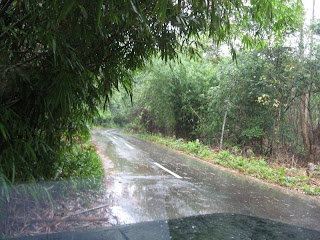 The next morning provided the most interesting drive of the visitation for me. We drove over a narrow road, badly in need of maintenance, through the thick forests of Borneo. At times, it felt like the forest would swallow the road completely. Along the way, however, we also saw large areas along the side of the road that had been clear-cut and burned to allow for planting rice (notice the empty land to the right of the road in the video).
I was saddened to see pristine forest land destroyed, but at the same time I knew that the growing population of Indonesia (and the world) combined with increased food consumption meant that additional land was needed to grow crops. I realized that balancing concerns about the environment and protecting habitats with the need to grow more food was not easy to do. The friars are also keenly aware of the dilemma, and many mentioned a desire to see more involvement within the Province in farms that model sound environmental practices. In Menjalin, I met with the three friars who work in the local parish and school. This is not your ordinary parish, however, The pastor estimated there are roughly 41,000 Catholics in his parish, scattered among more than 180 outstations. Several of these outstations see a priest only once a year.
 After lunch, I went to a Marian shrine not far from Menjalin that belongs to the diocese, but is cared for by the friars. There, I met the Provincial Minister, Brother Petrus Rostandy, who had come to inspect the installation of statues for the Via Crucis, which winds its way through the dense growths of trees, bamboo and tropical plants. During the months of May and October, he told me, thousands of people will come to the shrine each Sunday for Mass and other prayers. Near the shrine’s entrance, there is a large, grassy area where pilgrims can eat their lunches after Mass. There are also four small ponds there stocked with fish. One of the workers at the shrine netted a few fish that Petrus intended to serve to John Antony and I as our last meal in the Province. He also spotted three bamboo shoots that he took to serve us. (Unfortunately, our plans changed, and we were unable to enjoy either the fish or the bamboo shoots.)
After visiting the shrine, I went with Petrus to the Provincialate in Pontianak, where I met with the three brothers living there. On the morning of Saturday, 9 August, I was taken a short way down the road to the friary of St. Augustine, where I met with the three brothers of that friary. Two of the three work in the parish of St. Augustine, and the other is the provincial secretary/bursar. Like the other parishes in the province, St. Augustine not only has a sizeable local community to serve, but has many outstations that need to be served, as well. In the afternoon, I visited the friary of St. Yusuf, which is also quite near the Provincialate. The friars here administer a carpentry school. When the province was young, the carpentry school not only provided the furnishings for the friaries, schools and churches that the Capuchins were building, but it also trained friars to carry on the work in the future and provided job training for the local men. Although it still provides some occasional furnishings for the churches and schools of the diocese, it is mainly a training center for local men today.
 Having completed our visitation of all the friars of the province, John Antony and I met with the Provincial Definitory on the morning of 10 August to review our recommendations. Later that morning, we were taken to the airport where we departed for Jakarta and ultimately our next destination—Japan.
The overriding impression I had while visiting the Province is that the friars are very hardworking. The size of the parishes and the number of outstations they serve are staggering. Because the number of local clergy is still very small, the Diocese is almost totally dependent upon the Capuchins (although in recent years, a few other religious congregations have begun working in the Diocese). Although most friars expressed a wish that the Province would have more vocations, they receive a fair number of candidates each year. While it suffers from some of the problems that are common among young jurisdictions, it seems to me that the Province has a bright future.
 The parish served by the Pontianak Province is in an area called Tebet, and the church and school is under the patronage of Saint Francis of Assisi. I was surprised to learn that one of the former students of the elementary school is Barack Obama, current candidate for President of the United States.
 The Pontianak Province was formed when the Indonesian Province, founded by Dutch missionaries, was divided into three provinces about 20 years ago. It currently counts about 140 friars, of which about 35 are in temporary vows. Other than the friary in Jakarta and a small presence in Central Kalimantan, the friars minister mainly in the Diocese of Pontianak, in the western part of Borneo (or Kalimantan, as it is knows by the Indonesians).
 Brother John Antony arrived in Jakarta on 2 August, and the next day we both flew to Pontianak, located near the western tip of the island of Kalimantan. On the morning of 4 August, John and I were privileged to participate in the profession ceremony for three brothers making perpetual vows and three others making temporary vows. The Church of St. Augustine was filled to overflowing for the beautiful ceremony, which included elements from the local Dayak culture.
  At the end of the ceremony, the Provincial Minister, Brother Petrus Rostandy, called John Antony and I up to the sanctuary and introduced us to the assembly. Since he spoke in Indonesian, I'm not sure what he said, but everyone wanted to have a photograph with us after the ceremony!
 In the afternoon, John Antony and I went our separate ways to continue our visitation. I traveled north to Singawang, where two brothers minister in a parish, then on to the novitiate in Poteng. The province currently has seven novices.
On Tuesday, 5 August, I traveled three hours by car to Sambas. Brother Yosnianto was both my driver and my interpreter on this trip and for the next two days. In Sambas, two friars of the province serve in the parish. Sambas is home to the Sultan for this area of Kalimantan. While he no longer holds much political power, the Sultan still maintains a palace here. The Muslim presence was much more evident here than in the other places I had visited in Kalimantan, but relations between the various religions is usually good, I was told.
The next morning, we basically retraced our steps from the day before to go to Nyarumkop, which is only a few kilometers from the novitiate. Here, six brothers work in a parish, in boarding facilities for the boys attending the diocesan elementary and secondary schools and in the diocesan minor seminary. In the afternoon, I made a short visit to the Capuchin Poor Clare monastery in Singawang. To my surprise, I met Sr. Paula there, a Capuchin sister I had driven from Mercatello to Rome many years ago, when she was studying in Italy. She was equally surprised to discover that I was now a General Definitor!
 Leaving the coastal area behind, I moved further inland on Thursday morning. With Brother Yosnianto at the wheel, and accompanied by Brother Joseph, our three hour trip took us to Sanggau Ledo. There are two friaries in Sangau Ledo: one is attached to a parish, the other was built for the friars caring for the province’s extensive farm. At present, there are three friars at the parish friary and only one at the farm friary. The latter friary is built in the form of a traditional Dayak longhouse. The farm, which produces a modest income for the province, grows corn (maize), bananas, papaya, durian, and several other varieties of fruits. The friars are in the process of planting hundreds of rubber trees since the latex they provide is very profitable.
  The next morning provided the most interesting drive of the visitation for me. We drove over a narrow road, badly in need of maintenance, through the thick forests of Borneo. At times, it felt like the forest would swallow the road completely. Along the way, however, we also saw large areas along the side of the road that had been clear-cut and burned to allow for planting rice (notice the empty land to the right of the road in the video).
I was saddened to see pristine forest land destroyed, but at the same time I knew that the growing population of Indonesia (and the world) combined with increased food consumption meant that additional land was needed to grow crops. I realized that balancing concerns about the environment and protecting habitats with the need to grow more food was not easy to do. The friars are also keenly aware of the dilemma, and many mentioned a desire to see more involvement within the Province in farms that model sound environmental practices. In Menjalin, I met with the three friars who work in the local parish and school. This is not your ordinary parish, however, The pastor estimated there are roughly 41,000 Catholics in his parish, scattered among more than 180 outstations. Several of these outstations see a priest only once a year.
 After lunch, I went to a Marian shrine not far from Menjalin that belongs to the diocese, but is cared for by the friars. There, I met the Provincial Minister, Brother Petrus Rostandy, who had come to inspect the installation of statues for the Via Crucis, which winds its way through the dense growths of trees, bamboo and tropical plants. During the months of May and October, he told me, thousands of people will come to the shrine each Sunday for Mass and other prayers. Near the shrine’s entrance, there is a large, grassy area where pilgrims can eat their lunches after Mass. There are also four small ponds there stocked with fish. One of the workers at the shrine netted a few fish that Petrus intended to serve to John Antony and I as our last meal in the Province. He also spotted three bamboo shoots that he took to serve us. (Unfortunately, our plans changed, and we were unable to enjoy either the fish or the bamboo shoots.)
After visiting the shrine, I went with Petrus to the Provincialate in Pontianak, where I met with the three brothers living there. On the morning of Saturday, 9 August, I was taken a short way down the road to the friary of St. Augustine, where I met with the three brothers of that friary. Two of the three work in the parish of St. Augustine, and the other is the provincial secretary/bursar. Like the other parishes in the province, St. Augustine not only has a sizeable local community to serve, but has many outstations that need to be served, as well. In the afternoon, I visited the friary of St. Yusuf, which is also quite near the Provincialate. The friars here administer a carpentry school. When the province was young, the carpentry school not only provided the furnishings for the friaries, schools and churches that the Capuchins were building, but it also trained friars to carry on the work in the future and provided job training for the local men. Although it still provides some occasional furnishings for the churches and schools of the diocese, it is mainly a training center for local men today.
 Having completed our visitation of all the friars of the province, John Antony and I met with the Provincial Definitory on the morning of 10 August to review our recommendations. Later that morning, we were taken to the airport where we departed for Jakarta and ultimately our next destination—Japan.
The overriding impression I had while visiting the Province is that the friars are very hardworking. The size of the parishes and the number of outstations they serve are staggering. Because the number of local clergy is still very small, the Diocese is almost totally dependent upon the Capuchins (although in recent years, a few other religious congregations have begun working in the Diocese). Although most friars expressed a wish that the Province would have more vocations, they receive a fair number of candidates each year. While it suffers from some of the problems that are common among young jurisdictions, it seems to me that the Province has a bright future.
Subscribe to:
Posts (Atom)